

Human Rights Education • Game-Based Learning • Expert Facilitation
tested in 100+ game-play sessions
in corporate, governmental, educational and community settings:




Play. Re-think. Un-learn.
Difficult topics deserve bold conversations.
One Way Ticket is a human rights educational tool and a fair-minded companion in inclusion trainings on mobility justice. Designed in 2022, the board game was developed to challenge prevailing perceptions about migration and security worldwide, to raise empathy among the general public and reckon with racial discrimination and other forms of othering. It takes players and playeresses on a journey to advance understanding of migration issues and ask ourselves: who are the people behind the migratory statistics and what are their stories?Why do some tend to downplay certain situations of human suffering?Who has the right to protection?Who can leave?Who will be forced to stay and under which conditions?What does belonging mean?What is a migration narrative you frequently encounter in your own country or context?Whom does dehumanising migration narrative serve, and whom does it flatten?Whose voice should be centred in how migration stories are told?Who is typically telling the story of migration?What emotions does this migration narrative provoke in you?
We take fun seriously.
That's why One Way Ticket exists as a table, not a feed. No algorithm decides what you see next, no notification pulls you away mid-thought. Just people, sitting across from each other, working through a decision that has real weight, together, in the same room. It's slower than scrolling, and that's exactly the point. Real understanding doesn't happen in three seconds. It happens over ninety minutes, a shared table, and a conversation you can't swipe away from.

What is the game about?
Not another DEI training. A real experience.
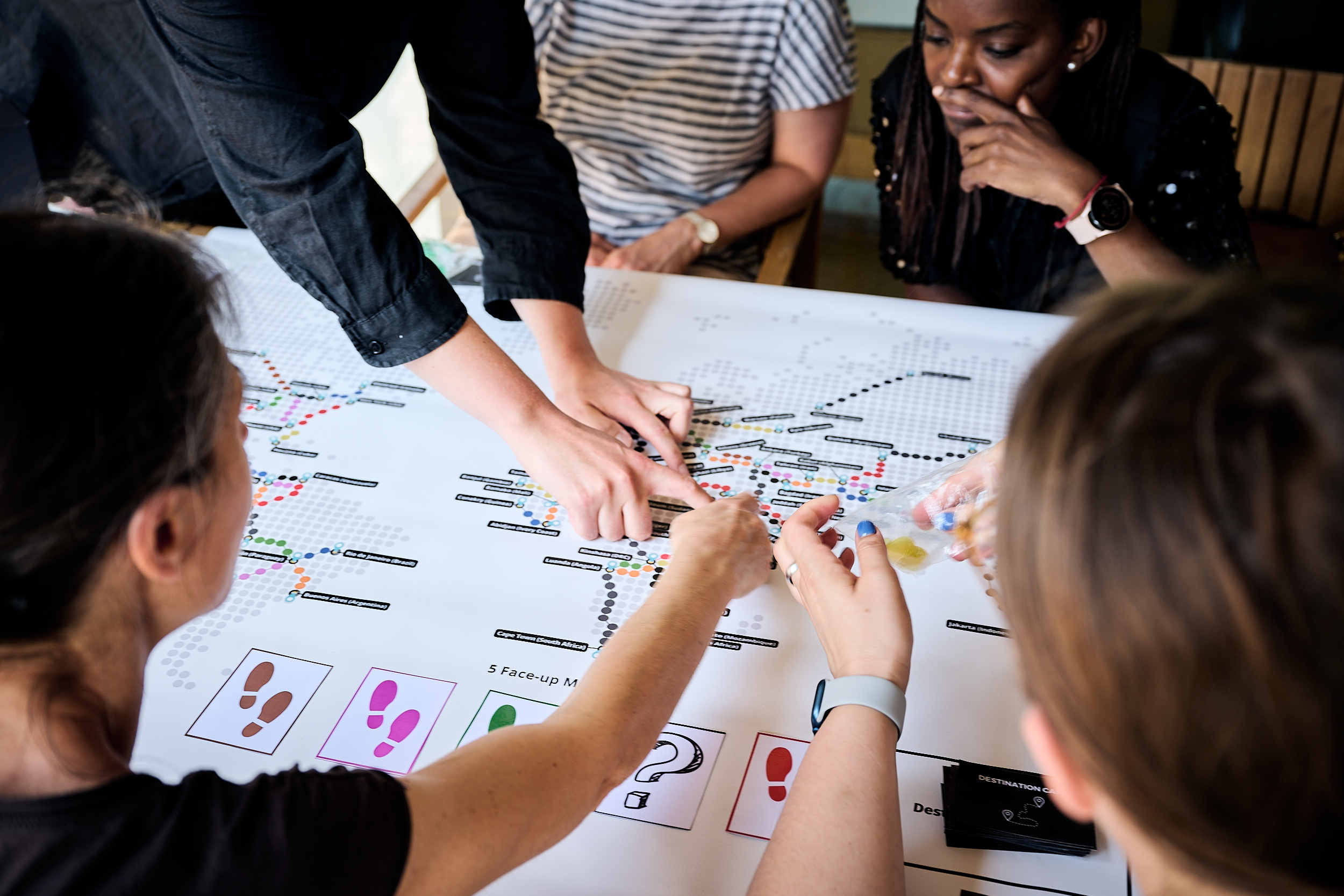
One Way Ticket is a multiplayer board game with expert facilitation that takes players through realistic migration scenarios. Narratives about migration in public discourse are too often dominated by fear and prejudice. One Way Ticket creates a safe space where organisations can have honest, deep conversations about mobility justice, human rights, and global interdependencies. The game fulfills the goals of global education and focuses primarily on creating an alternative to the colonial and Eurocentric narratives that dominate public space, as well as strengthening openness to diversity.
Examples of topics taken up in the game are (but not limited to) politics of movement, human rights, global challenges and interdependencies, the power of a passport, border control, climate crisis, gender inequalities and more. No prior knowledge required.
How the game works?
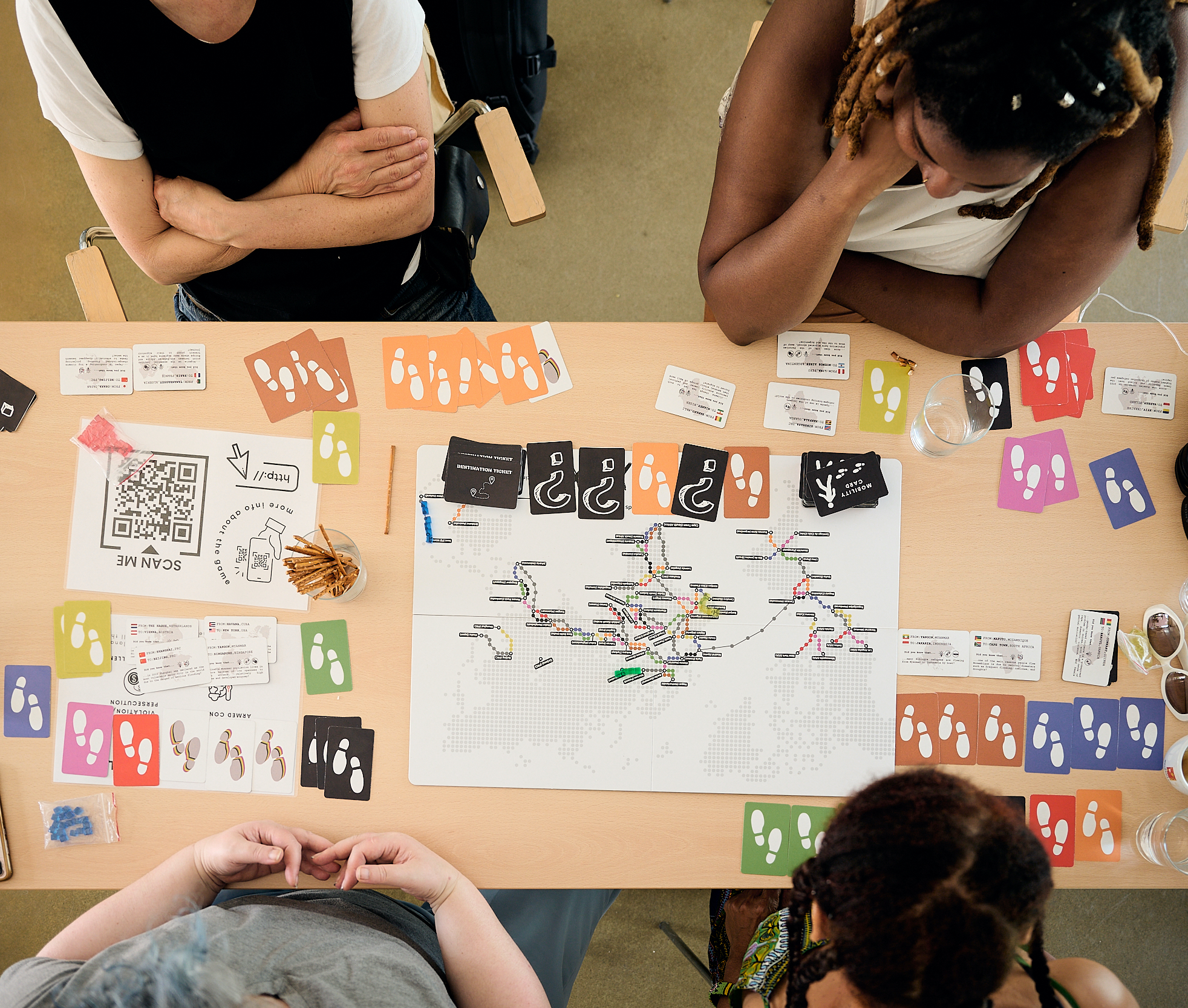
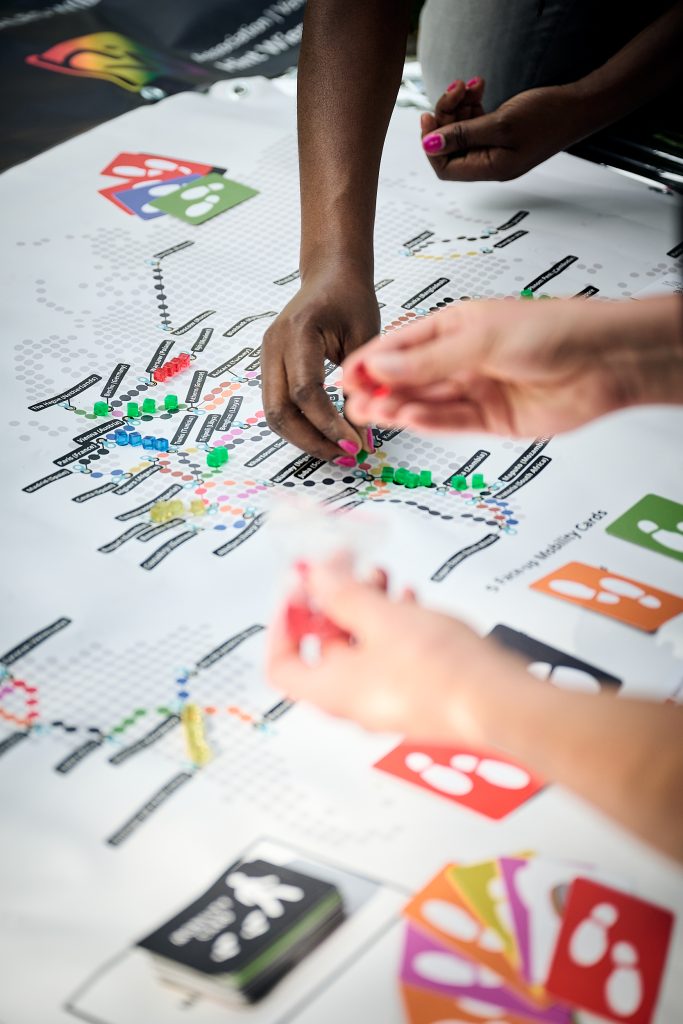
One Way Ticket is a board game that simulates the ‘simplified’ experience of long haul to safety within the main migration routes in the world. It is a competitive strategy game for up to 4 players. Your goal is to reach your destinations by completing as many migratory routes as possible, while learning about the real-life scenarios of migrants and refugees around the world. Remember, however: the world does not treat everyone equally. As you move, you collect routes, face border events, gain or lose privilege. This board game attempts to provide inventive storytelling that not only allows the players to step into migrants' shoes but also consistently produces an engaging conversation on often controversial topics in a relatively risk-free environment, giving insight into real-life scenarios of refugees. One Way Ticket allows you to experience difficult and ambiguous situations that in real life no one wants to experience yet many are forced to do so.
Gameplay Overview
In One Way Ticket, you step into the role of people on the move, navigating the world’s major mobility corridors. Each player begins with a set of Destination Tickets that define the migratory goals they must complete, along with an initial level of privilege that affects how easily they can move across the map. The game unfolds on a board depicting a network of migration routes, border crossings, and risk points that reflect real patterns of mobility.
🌍 Movement and Route Completion
On your turn, you perform one of the available actions:
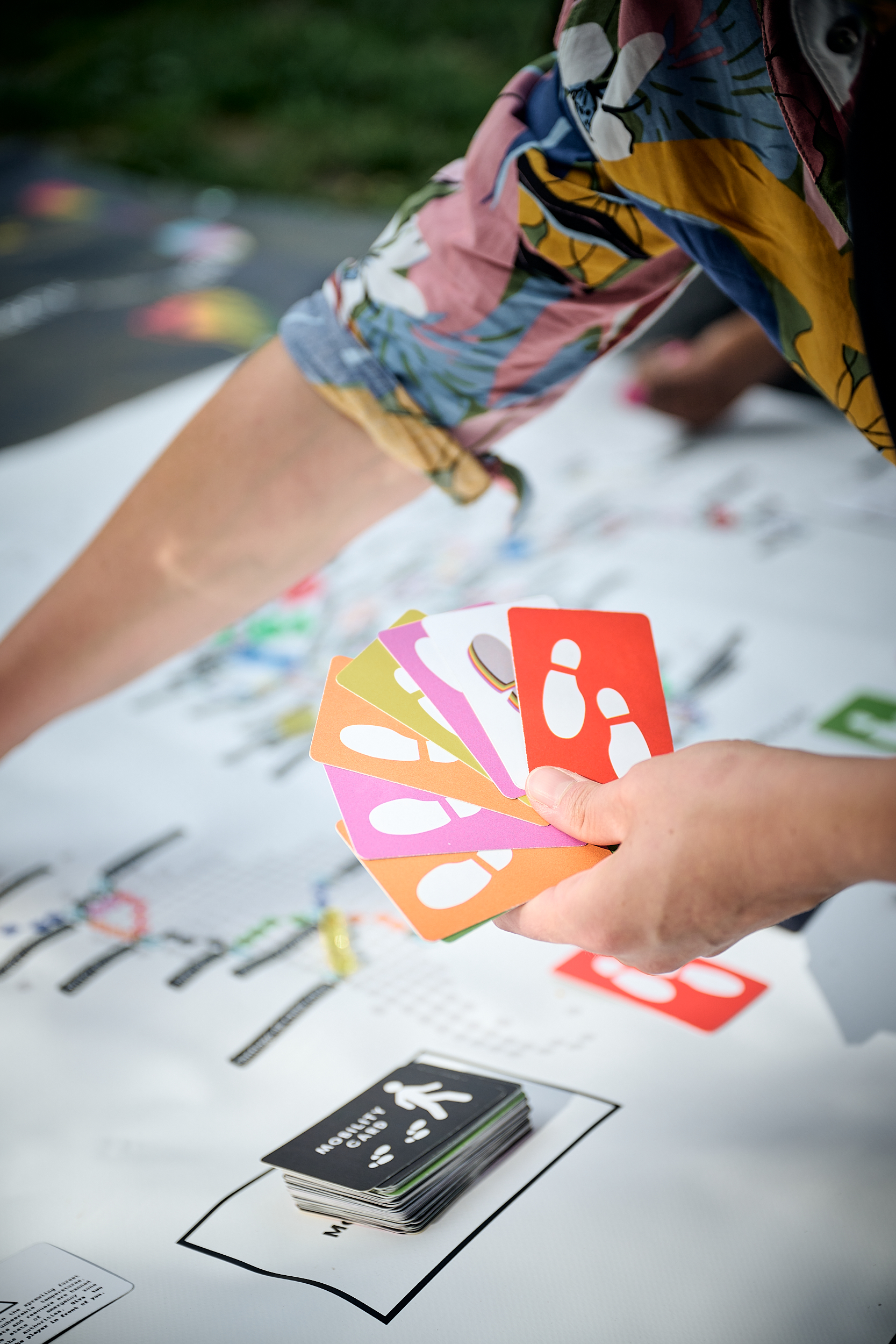
- Drawing Mobility Cards: draw 2 Mobility Cards from the deck or 1 face-up Special Mobility Card (instead of two regular cards). Mobility Cards are the core resource used to claim routes.
- Claiming a Route: play a set of Mobility Cards from your hand that match the colour and number of spaces on the chosen route. The claimed route becomes part of your network and may help you complete Destination Tickets.
- Drawing Destination Tickets: draw 3 new Destination Tickets, keeping at least 1. Any unkept tickets go to the bottom of the deck. New goals can earn high points, but uncompleted tickets at the end of the game result in Barrier Tokens.
Each completed route brings you closer to your objectives, but not all paths are equally accessible. Border conditions shift dynamically, influenced by random events, political tension, and your position within the system.
⚠️ Border Events and Mystery Cards
During the game, you may encounter Mystery Cards, representing the unpredictability of migration:
- Obstacle: a blockage, refusal, or catastrophe. You immediately receive a Barrier Token.
- Help: something works in your favour. Follow the instructions.
- Trade: a trading opportunity opens for all players, allowing free negotiation of Mobility Cards.
Mystery Cards may remain among the face-up cards on the board, but they are always placed face-down to preserve the element of surprise.
These moments reveal the game’s reflective nature: they show how invisible structures, politics, origin, family history, can simultaneously protect and restrict.
🧩 Strategy, Interaction, and Privilege
Although each player pursues their own goals, routes often intersect, and one player’s decisions can affect others. You may:
- block key passages,
- take advantage of open borders before they close,
- risk a more difficult route for a greater reward,
- support or hinder other players’ movement.
Your decisions also influence the Privilege Track, which mirrors real-world inequalities in mobility. Helpful events, long routes, or entering high-privilege zones may raise your level. Barriers, refusals, and blocked paths may lower it.
At the start of the game, each player also draws a Root Cause Card, defining their secret migration story and an additional objective: complete at least 2 tickets from the assigned category (War, Climate, Violence, Economic).
🎯 End of Game
The game ends when a player has 0 to 2 markers remaining at the end of their turn. Each player then takes one final turn, followed by scoring, the Mobility Score.
You earn points for:
- completed routes (1 to 3 ⭐ depending on length),
- high privilege level,
- the longest continuous chain of connected routes,
- fulfilling your Root Cause Card condition.
You lose points for:
- Barrier Tokens (each is -1 ⭐),
- low privilege level,
- failing to meet your Root Cause Card condition.
The winner is the player who navigates this world most effectively, a world where borders are forces shaping who may move, how far, and at what cost.
Why it works?
Three powerful dimensions of lasting change.
01
Change of perspective
Challenges prevailing perceptions about migration and security worldwide, leading to genuine mindset shifts, not just declarations.
02
Empathy rise
Brings a better understanding for the difficult journeys taken by migrants. Players don't hear statistics, they live decisions.
03
Transformation of complex matters
Shifts the heavy topics on migration and climate emergency into an enlightening, critical conversation to advocate for and educate about human rights.
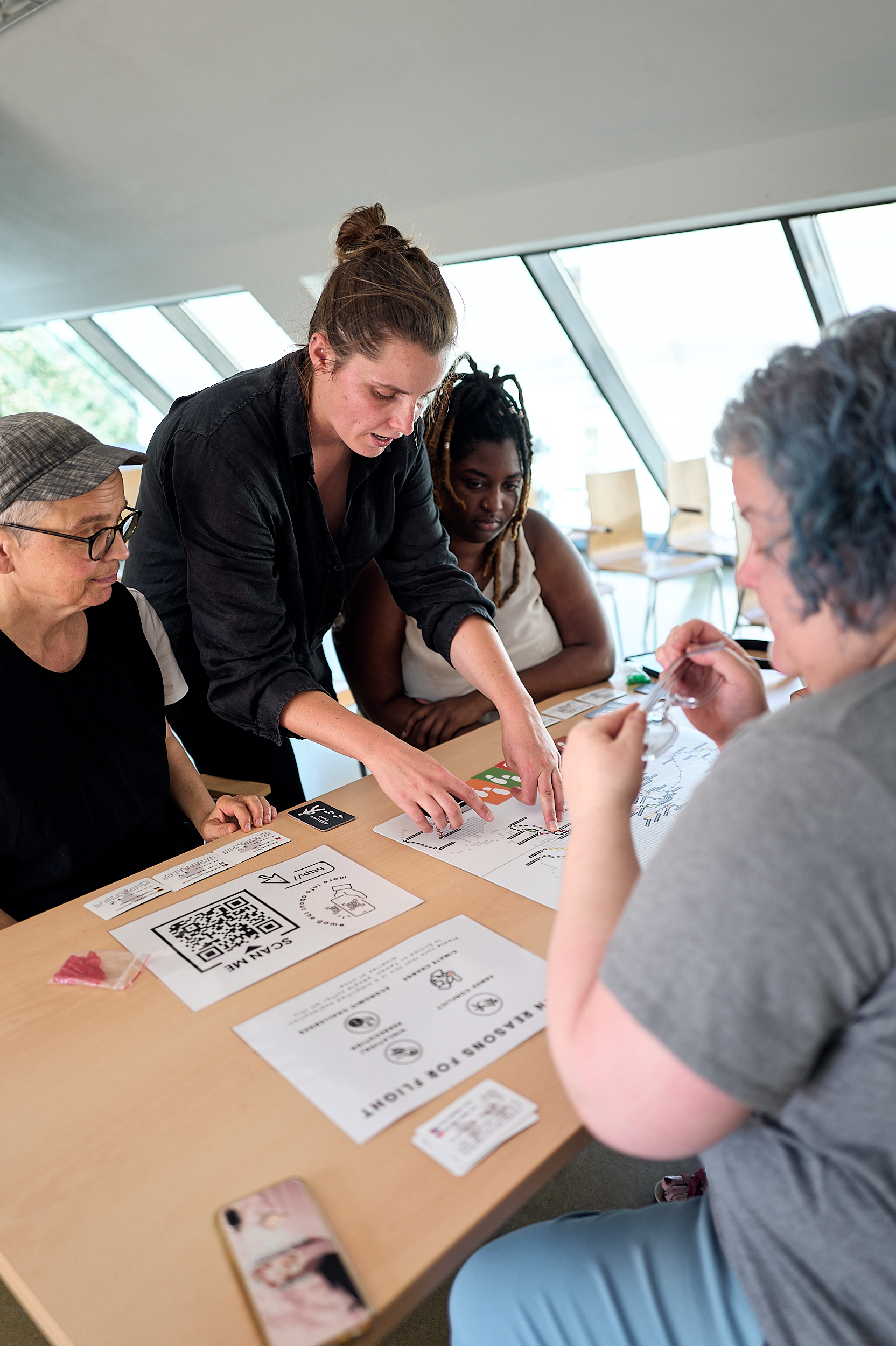
Why we run workshops only with a trained facilitator?
Democracy is no longer shaped only in parliaments, classrooms, or public squares. It is shaped in social media feeds, algorithms, and digital infrastructures that influence how we think, relate, and act. In a time marked by disinformation, polarisation, and growing mistrust, democratic values and human rights are not only challenged, they are being redefined. And this needs to happen offline too. One Way Ticket isn't recycled slides or another feed to scroll past. It's an energising, live encounter that opens minds and breaks down stereotypes, built to learn and unlearn on the topic of human rights and migration. A conversation that simply can't be clicked through.
Without a trained, committed and skilled facilitator, a game-based training on human rights could drift away from its original purpose. The topics we address, migration, racism, passport privilege, can trigger strong emotions and unexpected group dynamics. A qualified facilitator not only runs the game but ensures the psychological safety of participants, making sure that difficult conversations lead to reflection, not conflict. That is why the game set is not for sale, we offer facilitated trainings only.

Who can play?
Everyone willing to learn and unlearn. We run facilitated sessions on request, as a standalone event or as part of your training programmes, team-building activities and strategy away-days. Whether you lead a corporate team, a government unit, an NGO, or a community, if you're ready to move beyond surface-level diversity training, this is for you.
Want to book a workshop session?
1 - Get in touch
Tell us about your organisation and what you hope to achieve. We'll respond within 48 hours.
2 - We shape the session and send proposal
We tailor the format, duration and context to your group's needs and goals. Also, we charge a fair fee with tailored quote.
3 - Workshop at your community
An experienced facilitator runs the session. Quality and group safety guaranteed.

Migration runs through Judyta’s family, generation after generation. Her great-grandfather left the Austro-Hungarian Empire for what is now southern Poland. 🇦🇹 Her grandfather moved from present-day Ukraine to the west of the country. 🇺🇦 Her grandmother came from the Minsk region of Belarus. 🇧🇾 Three borders, three departures, one family.
Decades later, Judyta made her own crossing, to Vienna, in pursuit of a better education. But hers was a privileged path: unlike her ancestors, who fled hunger and death, she chose to go. That contrast never left her. Her own mobility let her feel both the ease and the friction of moving within the EU, an experience many of her closest friends never got to have. They’ve lived the injustice of institutionalised discrimination firsthand, the same borders that opened for her closing in front of them. 🌍
Later, working in the humanitarian field, she saw that gap play out daily: how hard it is to make people understand the structural nature of borders, how walls, checkpoints, patrols, and databases turn crossing points into places where thousands die every year. The real cost of migration, measured not in policy, but in lives.
🎙️ Join me for a thought-provoking podcast series on migration
Together, we'll explore the human stories, challenges, opportunities, and global impact of migration through engaging conversations and diverse perspectives.
Good ideas needs fuel...
This one needs yours. Back us on Kickstarter.
One Way Ticket started as a belief that difficult conversations can be transformative and that a game can be the safest place to have them. Over 100 sessions later, the impact is real. Now it's time to scale. The Kickstarter campaign will fund customised illustrations and professional graphic design, making One Way Ticket the first migration-focused board game backed by a community and funded by a woman. The experience of every participant must be meaningful, memorable and magical. Your support makes that possible. Join the campaign. Back One Way Ticket on Kickstarter.